
BIM4LCA
Model-based life cycle assessment for sustainable infrastructure projects
Making sustainability measurable throughout the entire lifecycle.
Rail is a key component of sustainable mobility, but its infrastructure causes emissions. Reliable methods are needed to transparently assess these emissions over the entire life cycle of the infrastructure – from construction, operation, maintenance and servicing through to demolition, dismantling and reuse as required for a circular economy. BIM4LCA uses digital structure data to perform a standardized life cycle assessment (LCA).
What is BIM4LCA?
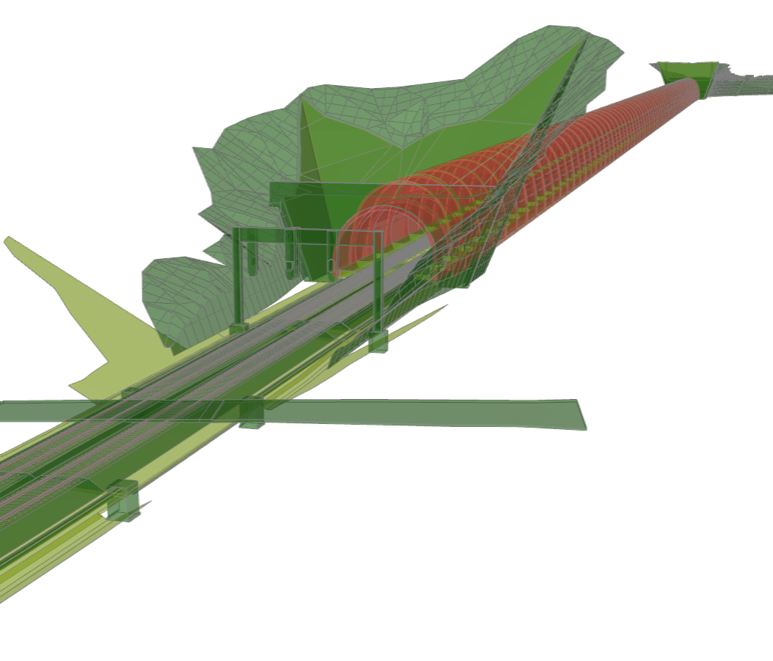
Model-based life cycle assessment
BIM4LCA enables the digital, model-based life cycle assessment of infrastructure and construction projects in accordance with DIN EN ISO 14040/14044 to determine environmental impacts over the entire life cycle.
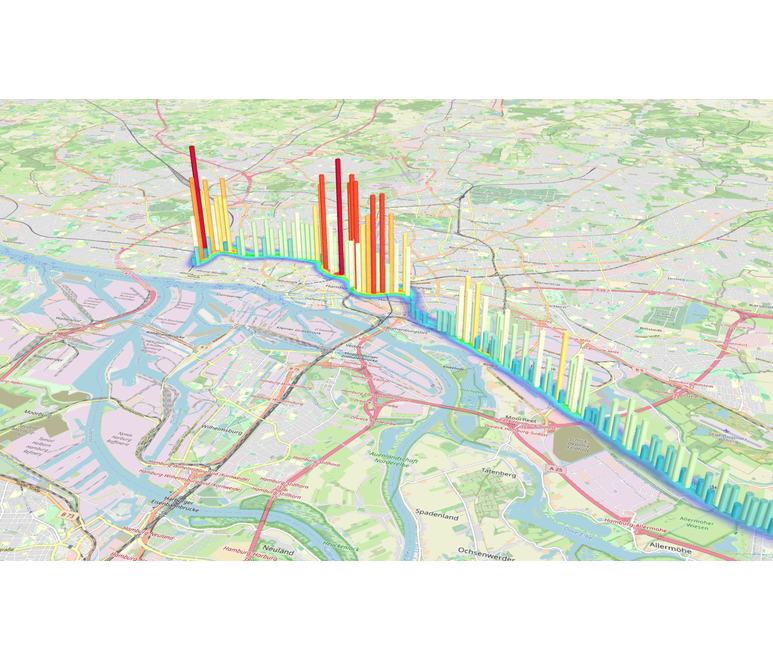
Consistent data basis
The basis is formed by BIM models and GIS data, which are combined with standardized life cycle assessment data for building materials and products in the form of environmental product declarations (EPDs).
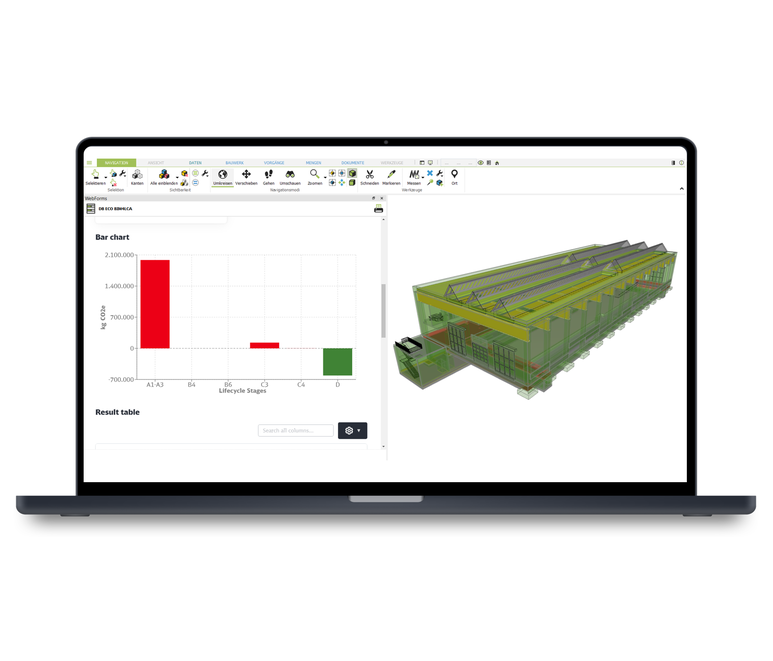
Improving the quality of decisions
The results of the life cycle assessment can be visualized directly in the BIM model and integrated into decision-making processes as part of the planning – in this way, sustainability can be embedded early on in the project.
Benefits of the solution
- Fast comparison of design options: Automated evaluation directly from BIM and GIS data enables fast planning iterations and an efficient comparison of planning options.
- More accurate data basis: Accurate quantity take-off from the digital model reduces sources of error and improves the quality of the life cycle assessment.
- Holistic planning: Mapping the entire life cycle of the infrastructure supports more sustainable planning decisions in the early project phases.
- Seamless integration into BIM workflows: BIM4LCA can be flexibly integrated into existing digital planning processes, BIM specifications and tool landscapes.
- Support of sustainability requirements: The model-based life cycle assessment facilitates the consideration of sustainability goals as well as the preparation for certifications (e.g. according to DGNB – German Sustainable Building Council).
Uses in infrastructure design
- Design
- Planning of stations, plants and maintenance sheds
- Planning infrastructure projects such as tunnels, bridges or rail lines
- Planning of administration buildings and other building construction projects
- Comparison of design options in early planning phases
- Optimization of material use and construction methods
- Sustainability assessments for certifications
- Emission studies on certain types of components (e.g. comparisons of different façade systems in building construction planning)
- Object-level analysis of the lifecycle of infrastructure assets
Questions and Answers
BIM4LCA is a digital engineering solution from DB Engineering & Consulting that enables a model-based life cycle analysis or life cycle assessment in accordance with DIN EN ISO 14040/14044. Information from BIM models or GIS data is automatically linked with relevant environmental information so that the environmental impact of structures can be calculated and evaluated over their entire life cycle. BIM and GIS data are established, indispensable core components of modern digital infrastructure planning.
The life cycle assessment provides a sound basis for evaluating various environmental indicators, such as greenhouse gas emissions or energy consumption, and integrating them into planning.
BIM4LCA is supplemented by consulting and planning expertise in the field of sustainable construction and BIM, so that sustainability aspects can be systematically taken into account in projects from the outset – supported by digital methods such as BIM and GIS.
BIM4LCA makes the ecological impact of construction projects visible and comparable at an early stage. This allows you to make a sound assessment of planning options with regard to environmental impacts such as greenhouse gas emissions – emissions that can arise over the entire life cycle, from construction through the operating phase with possible maintenance and repair scenarios to demolition and a possible recycling scenario.
The life cycle analysis or life cycle assessment is the right method for this – it can be used as a planning tool to consciously focus planning on sustainability and on the entire life cycle of the planned structures.
Sustainability goals of the project can be actively supported with BIM4LCA in the early project phases. The automated life cycle assessment with BIM4LCA also forms a very good basis for building certifications, e.g. as part of DGNB building certification.
BIM4LCA is based on a standardized workflow that automatically links BIM data with environmental information. The workflow is fundamentally based on the life cycle assessment process in accordance with DIN EN ISO 14040 and 14044.
- Determining the life cycle assessment target and framework
- Quantity take-off from the BIM model (alternatively also from GIS data)
- Assignment of suitable EPD data records
- Calculation of emissions and environmental impacts
- Visualization of the results directly in the model
- Developing recommendations for action for planning and feeding the findings back into the planning process
The system works with common open BIM formats such as IFC and can be integrated into existing planning processes.
BIM4LCA follows the recognized international standards for life cycle assessments: DIN EN ISO 14040/14044 (principles and requirements for life cycle assessments), DIN EN ISO 14025 and DIN EN 15804 (environmental product declarations, EPDs).
BIM4LCA can support decision-making processes throughout the entire planning process – from the feasibility study to acceptance.
The focus is on investigations into design options in the early project phases (feasibility study, concept design, and preliminary design), as this is where the key planning decisions are made. However, life cycle assessment can also make sense in later phases.
In early phases (HOAI phases 1-3), design options are compared (“Early Carbon Assessment”), in the approval and detailed design (HOAI phases 4-5) the precise life cycle assessment with specific EPDs is carried out, in tendering and construction (HOAI phases 6-8) the bid evaluation according to environmental, social and governance criteria, and in operation (HOAI phase 9) the preparation of resource and material passports.
BIM4LCA was developed specifically for Deutsche Bahn’s infrastructure and building construction projects, but is also suitable for stations, auxiliary buildings, entire traffic corridors and engineering structures such as tunnels and bridges. Other traffic types and structures can also be mapped.
The calculation is based on recognized Environmental Product Declarations (EPDs) in accordance with DIN EN 15804, sourced from databases such as the German ÖKOBAUDAT life cycle assessment database or provided by the manufacturer for the specific component.
These data sets contain environmental parameters for materials and construction products such as concrete, steel, asphalt and insulating materials, as well as for means of transportation and energy consumption.
For railroad-specific components, DB Engineering & Consulting has its own EPD compositions for standard objects in railroad construction.
We will be happy to advise you on EPD availability and the necessary basis for a life cycle assessment in your project.
Traditional life cycle assessments are often created manually using quantity tables – a time-consuming, error-prone process. BIM4LCA automates these steps by extracting quantities and materials directly from the 3D BIM model and linking them to EPDs.
The result is faster calculations with a lower susceptibility to errors and a direct visualization of the emissions in the model. This allows the life cycle assessment to be visualized, documented and communicated transparently.
Yes. BIM4LCA is essentially software-independent and focuses on high flexibility in the planning process – in line with the OpenBIM principle. The basis for this is provided by open data standards such as IFC for BIM models (Industry Foundation Classes, DIN EN ISO 16739).
This makes the model-based evaluation compatible with data from executing BIM tools such as Revit or Allplan. This means that BIM4LCA can generally be easily integrated into existing BIM and planning workflows. BIM4LCA can be flexibly based on individual BIM specifications agreed in the project (in particular attribute requirements).
For the required environmental product declarations (EPDs), BIM4LCA works with the established, open ILCD format, which meets the requirements of DIN EN 15804. This means that your own company-specific EPDs can be integrated into the process if required.
Interested clients or planning teams can integrate BIM4LCA directly into their projects at the start of the project, or alternatively retrospectively as part of existing projects. In principle, the earlier environmental, social and governance criteria are embedded in the project, the greater the room for maneuver – and the more sustainable project decisions can be made.
In addition, a life cycle assessment accompanying the planning process enables the entire life cycle of the planned infrastructure to be consistently addressed throughout the project.
The life cycle assessment framework is defined on a project-specific basis in order to find the best possible solution for your project.
In addition to the life cycle assessment, project-related sustainability consulting is also beneficial. In this way, environmental, social and governance criteria can be taken into account in decision-making processes across all project phases.
DB Engineering & Consulting also offers workshops on rollout of BIM4LCA, support with integration into BIM processes and project-specific emissions and studies of design options.
With BIM4LCA, DB Engineering & Consulting is pursuing the goal of enriching infrastructure projects across the board with (partially) automatically generated sustainability indicators and metrics for decision-making. Building on this, the BIM use case forms the basis for generating material passports for structures and for material and resource analyses (recyclability).
DB Engineering & Consulting makes a direct contribution to the DB Group’s climate targets through BIM4LCA.